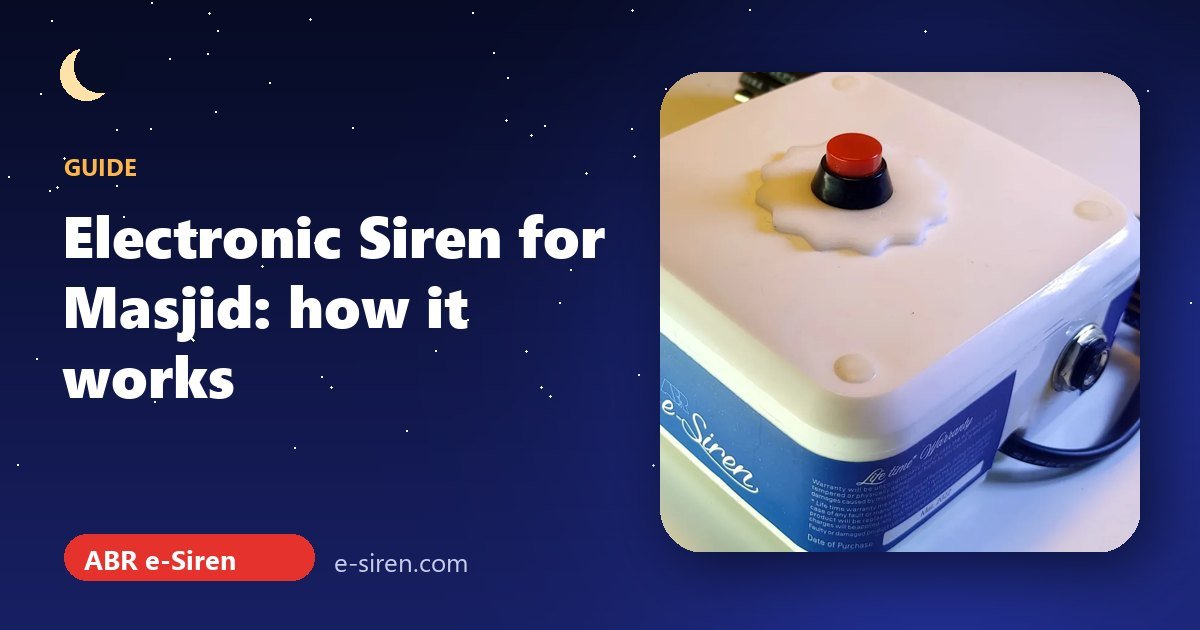
An electronic siren makes the siren sound with electronics instead of a motor. A small circuit generates the rising and falling tone, and your amplifier and loudspeakers make it loud. For a masjid, that means no heavy machine on the minar, no motor to repair before Ramadan and a power draw of less than 5 watts. The ABR e-Siren is an electronic siren designed only for masaajid, invented in 2018 by Dr. Abdul Rahman in Hyderabad.
How a traditional motor siren works
The classic air-raid style siren that many masjids still use is a mechanical device. An electric motor spins a rotor inside a perforated housing. As the holes line up and close, air is chopped into pulses, and those pulses are what you hear as the siren wail. Faster rotation means a higher pitch.
It works, but it comes with real costs for a masjid committee:
- Power: a 3 HP motor siren draws roughly 2,200 watts while it runs.
- Location: it has to sit outside, on the terrace or the minar, exposed to sun and monsoon rain for eleven months a year.
- Maintenance: bearings, windings and wiring need attention, and someone has to climb up every year to check it before Ramadan.
- Vibration: a spinning motor shakes the structure it is bolted to.
How an electronic siren works
An electronic siren replaces the motor and rotor with a microprocessor-controlled, variable-frequency sound device. Instead of chopping air, it produces an audio signal whose frequency rises and falls smoothly. That signal goes into an amplifier, and the amplifier drives the loudspeakers.
The ABR e-Siren produces the familiar Hi-Lo wail: an unbroken tone that slowly climbs and falls, the “wooooOOOOooee” sound people recognise from civil-defence sirens. Because the tone is generated electronically, it sounds the same on the first day of Ramadan and the thirtieth, and the same this year as next year.
Why a masjid does not need a separate siren speaker
Every masjid already owns the two expensive parts of an electronic siren: an amplifier and horn speakers on the minar for the azan. The e-Siren simply feeds its signal into that amplifier. Everything connected to it, whether one horn or eight, plays the siren together. The unit itself stays indoors, next to the amplifier.
Electronic siren vs motor siren at a glance
| Motor siren (3 HP) | ABR e-Siren (electronic) | |
|---|---|---|
| Power draw | About 2,200 W | 5V DC, 300 mA to 1 A (under 5 W) |
| Moving parts | Motor, rotor, bearings | None |
| Where it is installed | Outside, on the terrace or minar | Indoors, next to the amplifier |
| Installation | Technician, electrician, wiring | Two cables, plug ‘n’ play |
| Yearly maintenance | Needed | 0% maintenance |
| On inverter during a power cut | Too heavy for most inverters | Runs on the masjid inverter or UPS |
For a deeper look at running costs, read our motor siren vs e-Siren comparison.
What to look for when buying an electronic siren for a masjid
- The right tone. People in your mohalla need to recognise it instantly as the Sehri or Iftar signal. A steady Hi-Lo wail is clearer than a fast police-style yelp.
- Works with your existing amplifier. Avoid systems that need a new amplifier or new speakers. The ABR e-Siren connects with a standard ¼-inch (6.35 mm) jack cable to a MIC or AUX input.
- Low power, inverter friendly. Sehri is often when the power goes. Under 5 W, the e-Siren runs on your inverter or UPS alongside the amplifier.
- Simple controls. The person on duty at 4 a.m. should be able to operate it without training. The e-Siren has a single red button.
- A real warranty and service centre. The ABR e-Siren carries a lifetime* replacement warranty with a service centre in Hyderabad.
- Buy the original. The ABR e-Siren was the first electronic siren made exclusively for masaajid. Buy from e-siren.com or call 8500536007 so you get the genuine product and warranty.
Is an electronic siren loud enough?
Loudness comes from the amplifier and the horns, not from the siren box. If your azan is heard clearly across your area, the e-Siren will be heard just as far, because it plays through exactly the same system. Want more coverage? Add horns or use a stronger amplifier, just as you would for the azan.
One tip from our technical team: keep the amplifier’s input volume low for the siren channel and control loudness with the master. You get a cleaner siren sound and your amplifier stays healthy for years.
Electronic siren price
The ABR e-Siren costs ₹4,000, a one-time purchase that includes the unit, audio cable and warranty card, with all-India express delivery. There is no installation charge, because no technician is needed, and no yearly servicing bill.
Order the ABR e-Siren · ₹4,000 WhatsApp 8500536007Electronic siren for Ramadan: Sehri and Iftar
Most masjids use their siren twice a day in Ramadan: to mark the end of Sehri before Fajr and the time of Iftar at Maghrib. Our guide to the Iftar siren and Sehri siren explains how masjids time it, and the Ramadan Calendar 2027 lists Sehri and Iftar times for 16 Indian cities.
What is an electronic siren?
An electronic siren creates the siren tone with a circuit instead of a spinning motor. A microprocessor generates the rising and falling tone, and an amplifier and loudspeakers make it loud.
Is an electronic siren as loud as a motor siren?
An electronic siren is as loud as the amplifier and horn speakers it plays through. The ABR e-Siren uses your masjid amplifier and minar horns, so it reaches as far as your azan already reaches.
How much power does an electronic siren use?
The ABR e-Siren is rated 5V DC, 300 mA to 1 Amp, which is less than 5 watts. A 3 HP motor siren draws about 2,200 watts.
What is the price of the ABR electronic siren?
The current price is shown on the product page. It is a one-time purchase with a lifetime* replacement warranty and all-India delivery.